


Tracking down the best available evidence to answer your question
Once you have defined your question you will need to look for research evidence to help you find an answer. Where you look will depend on the type of question and what is available to you.
Here you will learn:
- How to define the search terms
- What type of evidence sources are appropriate to answer your question
- Where to look for the evidence
Getting started
-
Defining search terms to find research evidence
You can begin initial searches for research evidence using the keyword terms entered in your PICO (or similar) template used to define your question. Use each of these to run an initial search in one of the databases of peer-reviewed literature or within a specific journal. To find articles containing all of the key words combine the search terms using the Boolean connector ‘AND’. For example: paediatric AND life-limiting illness AND pain.
Once you have identified a relevant article(s) addressing your question, you can expand the list of search terms by using the article’s keywords. These are often included as part of the article’s abstract.
When you have your complete list of search terms move on to searching your evidence source such as a pre-appraised collection or literature database to find more articles relevant to your question.
Advanced searching
As well as keywords, the often used PubMed database also uses Medical Subject Headings (MeSH terms). These terms or ‘tags’ are added to articles entered in the database so that similar articles can be retrieved even if the authors choose different keywords. It is a more efficient way to search for related articles. However, it takes time for these terms to be added and so keywords are also needed to capture more recent articles.
Note: If other groups working in your area of interest use similar but not identical terms your search may not capture all relevant research. An information specialist librarian can help you with this. If you do not have access to this service then consider using a validated search filter.
If you have access to the pdf of your article(s) you can also use one of the freely available Keyword Finder tools for extracting keywords to help with this step.
 Example Keyword finders
PubReMiner – find suitable terms, relevant journals, and authors active in this field.
TerMine – Scan texts for high-frequency words and can be used with outputs such as EndNote generated abstracts to identify common terms across a set of articles.
Yale MeSH Analyser – Helps you to design a search strategy that includes all relevant keywords. -
What types of resources should I start with?
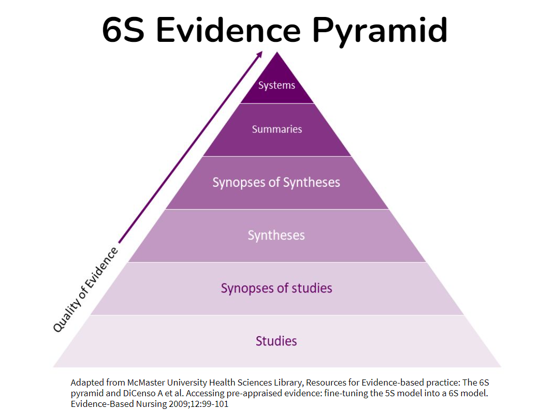
The 6S pyramid or hierarchy of evidence assists clinicians in deciding where to start with the most appropriate evidence. [1]
Synthesised evidence that considers evidence quality sits higher in the pyramid. So, you should start at the top and work your way down until you have identified relevant and useful evidence.
At the very top clinical guidelines and individual patient data are combined to guide personalised care. This is an emerging data application and you will find that most organisations do not yet have this level of support.
Guidelines (Summaries) are next and where available represent one of the best places to start your search for evidence in support of clinical decision-making. The evidence has been graded by experts based on strength, generalisability, and relevance of evidence, as well as applicability of any recommended changes to practice.
Beneath this you will find different forms of evidence summary (synopses of syntheses or single studies) and syntheses (systematic reviews and meta-analysis) of published research. These use rigorous approaches to identify bias and assess the quality of studies included in the review. Unlike guidelines they do not make recommendations. They may discuss the contexts of care and how the evidence might influence practice. Curated collections, journals, and databases can be used to identify these sources as well as individual studies.
At the bottom of the 6S Evidence Pyramid are individual studies. This is simply because it is not possible to know if outcomes from a single study are relevant to other groups, that is whether they can be generalised. However, it the population and context studied closely resembles your situation it may be useful.
Across each of the 6S levels a range of research study types might be drawn on including quantitative and qualitative research as appropriate. When selecting evidence from syntheses, synopses, and primary studies it is important to consider the Evidence hierarchy. But remember that although this guides us to select evidence based on methodology providing the greatest outcome certainty, the study designs required to achieve this are not always appropriate for some questions in palliative care. You can read more on Evidence Hierarchy in CareSearch.
Learn more
Complete the CareSearch learning module Finding clinical guidance with CareSearch. This module will explain how the Palliative Care guidelines, clinical Evidence pages, the Systematic Review collection and PubMed searches will assist you to provide better clinical care.
-
Access to palliative care evidence resources
Guidelines
Guidelines help you by making generalisable recommendations based on systematic analysis of the evidence. Importantly, the quality and strength of evidence is taken into consideration. Where evidence is lacking or uncertain then expert consensus might be used to provide guidance. See CareSearch for palliative care guidelines.
In palliative care many people present with multimorbidity and comorbidities. However, guidelines often address only a single condition and following guidelines for each condition would be both complex and stressful for the person and health professional. It may be necessary for you to search beyond local or single disease guidelines to find evidence relevant to caring for someone with the comorbidities of your patient. Guidelines for comorbidities are beginning to emerge. The Australian RACGP aged care clinical guide (Silver Book) considers and provides guidance for multimorbidity in the context of palliative care. The BMJ Best Practice Comorbidities is an example of guidance provided online to facilitate retrieval of information based on individual backgrounds.
Pre-appraised collections
-
Other resources for palliative care information
-
Literature databases and collections
-
Tips on searching and managing your literature
-
Using Search Filters
-
Searching CareSearch with your clinical questions



-
References
- Dicenso A, Bayley L, Haynes RB. Accessing pre-appraised evidence: fine-tuning the 5S model into a 6S model. Evid Based Nurs. 2009 Oct;12(4):99-101. doi: 10.1136/ebn.12.4.99-b.
- Sackett DL, Rosenberg WM, Gray JA, Haynes RB, Richardson WS. Evidence based medicine: what it is and what it isn’t. BMJ. 1996 Jan 13;312(7023):71-2. doi: 10.1136/bmj.312.7023.71.
Last updated 11 June 2026