


Special considerations for medicines in palliative care
The more health issues you or the person you care for have, the more medicines likely to be taken. Understanding what can affect which medicines you are prescribed in palliative care is important. So is knowing where you can find more information to help you manage your medications.
Access to medicines
There are three ways that medicines might be obtained:
- with a prescription from a health professional
- over the counter from chemists, health shops and supermarkets
- from homoeopaths, naturopaths and herbalists.
Taking your medicines
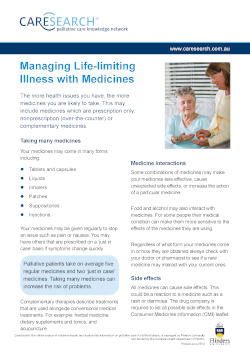
Medicines may come in many shapes or forms. You could take tablets, liquids, capsules, inhalers or patches. You may also use suppositories or have injections. Medicines might be taken in different ways or at different times of the day or night. As the illness progresses you may have to change how some medicines are taken. They could be taken for different reasons. Sometimes you or the person you care for may have more than one medicine to treat the same problem.
Common medicines in palliative care include:
- analgesics (to treat pain)
- antiemetics (to treat and also to prevent nausea and vomiting)
- laxatives (to prevent and treat constipation)
- antidepressants (to treat depression, or sometimes pain) and other medications such as sedatives.
These medicines may be given regularly to stop a problem such as pain or nausea. Others might be prescribed on a ‘just in case’ basis. These can be helpful as symptoms sometimes change quickly. In palliative care there are some special considerations for how medicines are managed.
Finding more information
You can find out about your medicines in many ways.
- Your doctor or pharmacist can give you information about your medicines.
- The healthdirect website has information about individual medicines.
- The National Prescribing Service has a Medicines Line for information on prescription, over-the-counter and other medicines including complementary medicines.
- Your local hospital may have a medicines information service. Call your local hospital and ask to speak with the pharmacy department.
- Drug companies are required to tell you about the medicine you are taking in a Consumer Medicines Information (CMI) leaflet. It aims to give you information that is accurate, fair and easy to understand. This is often inside the medicine box or packaging.
- Your doctor or pharmacist may suggest a Home Medicines Review (HMR). This can be helpful to look at the medicines that you are taking. Your pharmacist can do this at home for you, or perhaps at your doctor’s surgery. You can ask your doctor or pharmacist how this can be arranged.
Practical ways to manage medicines
Managing medicines is important, but it can be difficult. This may apply to yourself or someone that you are caring for.
You can easily forget to give or to take medicines, or even take them twice. You will find it easier if you use a medicines list to record this information. It is important that you take this list to your medical appointments. You should also ask your doctor to update this for you when your medicines are changed.
Sometimes, your doctor or pharmacist may suggest that you use a dose administration aid. This is a way to organise medicines so that they are easier to manage. Your pharmacist may be able to fill this regularly for you. There may be a cost for this service.

- Keep a list of what medicines you have and why you or the person you are caring for are taking them.
- Take your medicines lists to appointments. Either you or your doctor should keep this up-to-date. It can get confusing when some medicines are stopped and others are started.
- You may find that organising these different scripts takes time. Make sure you have enough medicines to last over weekends and public holidays. It is more difficult to get a repeat prescription at these times. You may want to use a diary or calendar note to prompt you when a new prescription is required.
- It may be helpful to use the same local pharmacy for your medicines. They will be able to stock the medicines that you are likely to need.
- You may have a lot of tablets, or some very large ones. This can occasionally make it difficult to swallow them. You may be able to get some or all of them prescribed in another way (such as an oral liquid or injection).
- Make sure that all medicines are kept safe. Store them properly according to the instructions and out of reach of young children and family pets.
- You must not keep medicines that you are not using or that are out of date. Take them to your pharmacy for correct disposal.
- You or the person you care for may be given medicines on discharge from hospital. These may, or may not, be the same as what was being taken at home. As this could get confusing, it is important that you clarify any changes with your doctor or pharmacist.
Adverse effects
All medicines can cause adverse effects. This is an unintended effect of a medicine. You will need to watch for adverse effects and monitor what is happening. This could be anything from a rash, to a wheeze, or diarrhoea.
You or the person that you are caring for may only experience some, or none of these effects. Discuss all adverse effects with your doctor or pharmacist. Some may just be temporary, while others may be a sign of a bigger issue.
Managing medicines resources
Last updated 12 June 2026